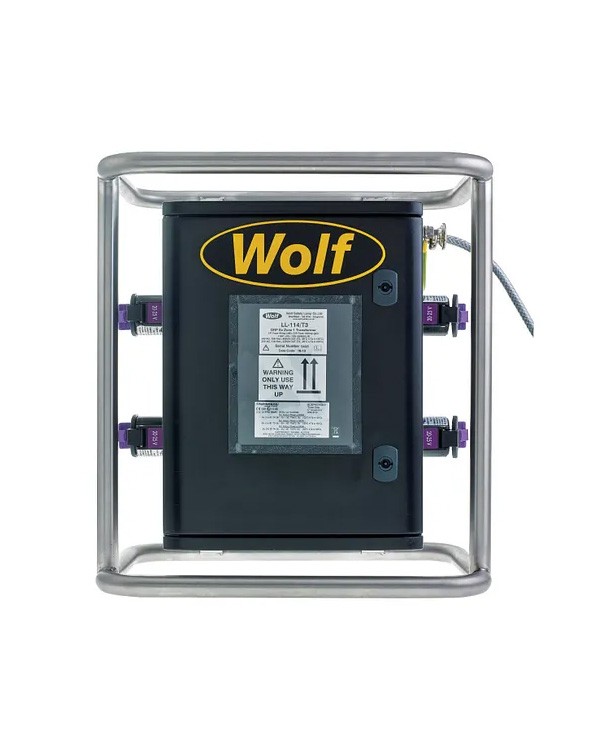
LL-114/T4, LL-214/T4, LL-221/T4, LL-133/T4, LL-233/T4, LL-234/T4
The Wolf ATEX 250VA Transformer is a professional ex-proof power unit designed to maximize safety while powering temporary lighting and electrical systems in hazardous areas. Offered by IST Safety Ltd, the official distributor of Wolf, this unit steps down high voltage to safe operating levels such as 24V or 110V, protecting personnel from electrical shock risks, particularly in wet and metallic conductive environments.
Certified for Zone 1/21, the transformer features a robust, impact-resistant, and corrosion-proof GRP (Glass Reinforced Polyester) enclosure, ensuring reliable performance in the harshest industrial conditions. Its compact and portable design provides significant ease for installation and logistics across all field applications, from refineries to tank cleaning operations.
|
ATEX 250VA TRANSFORMER |
||||||
|
Product Reference |
LL-114/T4 |
LL-214/T4 |
LL-221/T4 |
LL-133/T4 |
LL-233/T4 |
LL-243/T4 |
|
Product DescrIptIon |
GRP |
Stainless Steel |
||||
|
110V:24V |
230V:24V |
230V:110V |
110V:24V |
230V:24V |
230V:110V |
|
|
CODE |
For Output Power ≤ 250VA: Ex d e IIC T4 Gb - Ex t IIIC T130°C Db (-20°C ≤ Ta ≤ +55°C) |
|||||
|
Type of ProtectIon |
'e' increased safety, 'd' flameproof |
|||||
|
Area of ClassIfIcatIon(Gas) |
Zones 1 and 2 Gas Groups IIA, IIB and IIC |
|||||
|
Temperature Class (Gas) |
T4 |
|||||
|
Area of ClassIfIcatIon (Dust) |
Zones 21 and 22 Dust Groups IIIA, IIIB and IIIC |
|||||
|
Max. Surface Temperature (Dust) |
T130°C |
|||||
|
AmbIent Temperature |
-20°C to +55°C |
|||||
|
CertIfIcate |
ATEX - LCIE02ATEX6248X IECEX - LCI 04.0016X |
ATEX-LCIE02ATEX6118X IECEX - LCI 11.008X |
||||
|
Enclosure |
Glass reinforced polyester (GRP) enclosure, stainless steel skid |
Marine grade (316L) stainless steel |
||||
|
Power |
250VA |
|||||
|
Volts In |
110V ac +6% - 10% |
230V ac +6% - 10% |
110V ac +6% - 10% |
230V ac +6% - 10% |
||
|
Input Cable |
15m SY cable 2.5mm² with ATX 110V / 230V 2P+E plug fitted as standard |
|||||
|
Volts Out |
24V |
110V |
24V |
110V |
||
|
Socket Arrangement & ConfIguratIon |
4 output sockets ATX 110V / 24V 2P+E as standard |
|||||
|
2 sockets on each unit side |
||||||
|
DImensIons |
504 x 465 x 285 mm (L x W x H) |
512 x 562 x 260 mm (L x W x H) |
||||
|
Ingress ProtectIon |
IP66 |
|||||
|
WEIGHT |
|
|
||||
What is ATEX and what does exproof mean? The ATEX directive is a set of European Union standards that define the safety requirements for equipment used in hazardous areas with explosive atmospheres. Exproof (Explosion-proof) refers to protection methods designed to prevent explosions by inhibiting the formation of sparks or electrical arcs in environments containing flammable gases, dust, or vapors. To ensure life and property safety in industrial facilities, the use of ATEX-certified exproof devices is a legal requirement.
ATEX Zone coding is a technical classification based on the frequency and duration of the occurrence of an explosive atmosphere in a given area. While the terms Zone 0, 1, and 2 are used for risks originating from gas, vapor, and mist; the codes Zone 20, 21, and 22 are designated for environments containing combustible dust. This classification is a legal standard that determines the required Equipment Protection Level (EPL) for devices. Accurate zone identification both optimizes operational costs and minimizes occupational safety risks.
In addition to ATEX certification, some projects may also require the IECEx Certification System (International Electrotechnical Commission Explosive Atmospheres System) certification. IECEx is an internationally recognized conformity assessment system for equipment intended for use in explosive atmospheres.
While ATEX is a European Union directive and a legal requirement within the European market, IECEx is a globally accepted certification system, widely preferred in regions such as the Middle East, Asia, and Australia.
From a technical perspective, both ATEX and IECEx are based on similar standards (e.g., the EN/IEC 60079 series). However:
Therefore, while ATEX certification may be sufficient for certain projects, international tenders or critical industries such as oil & gas often prefer or require products that are certified to both ATEX and IECEx standards.
The appropriate certification should be determined based on the project location, client requirements, and application area.